


Post-event survey questions should tell you what attendees experienced and what to change next. Start with overall satisfaction, the most useful part, a specific improvement, and future interest. Add questions about content, access, venue, or technology only for people who experienced those parts.
These 30 original examples include attendee, speaker, sponsor, and staff questions. Choose a short relevant set for each audience; do not send all 30 to everyone. This guide expands our event feedback question bank while keeping the original article address.
A five-question post-event survey
For a workshop or customer event, start with questions 1, 4, 6, 26, and 30. They ask for satisfaction, a useful takeaway, one improvement, future interest, and anything you missed. Use a labeled satisfaction scale for the first question and keep comments optional.
Replace a question when the event's purpose demands it. A networking event may need question 13 about useful connections; a training event may need question 8 about what the attendee plans to apply. Start with an event satisfaction template or workshop feedback template, then edit a copy for the actual event.
Questions 1–6: overall experience and useful outcomes
- Overall, how satisfied were you with [event name]?
Offer Very dissatisfied, Dissatisfied, Neither satisfied nor dissatisfied, Satisfied, and Very satisfied. Ask before detailed diagnostics if you want an overall judgment not prompted by a list of problems.
- How well did the event match the description in the invitation?
Use Not at all well through Extremely well, plus "I do not remember the description." Review the promise made before the event, not just delivery.
- How relevant was the event to your reason for attending?
Use Not at all relevant through Extremely relevant. This helps distinguish audience fit from production quality.
- What was the most useful part of the event for you?
Use optional text. Let people identify an unexpected conversation or activity rather than limiting them to the agenda.
- How satisfied were you with the value of the event for the time you invested?
Use the satisfaction scale. Ask about ticket price separately if paid value is the decision; combining time and money can hide the cause.
- What is the one thing we should change for the next event?
Use optional text. A specific obstacle is easier to act on than a generic "How can we improve?" without context.
Questions 7–12: content, speakers, and learning
- Which session or activity was most relevant to your needs?
List actual sessions, with "None of these" and an attendance option. Ask only about sessions the person attended.
- What, if anything, do you plan to try after this event?
Use text and allow "Nothing yet." Intended application is a useful signal, not proof of later behavior.
- How clear was [speaker]'s explanation of [topic]?
Use Not at all clear through Completely clear, plus "I did not attend." Keep clarity separate from whether someone enjoyed the topic.
- How was the pace of [session]?
Offer Much too slow, A little too slow, About right, A little too fast, and Much too fast. Use it to revise the session plan.
- How useful were the materials or resources provided?
Use Not at all useful through Extremely useful, plus "I did not use them." Missing or unseen materials need a different fix from poor materials.
- Which topic needs more depth at a future event?
Use text or a shortlist of real options, including "No preference." This supports programming, not a guarantee that every request will be scheduled.
Questions 13–18: participation, access, and logistics
- How well did the event help you meet people relevant to your goals?
Use Not at all well through Extremely well, plus "Networking was not my goal." Do not treat everyone as a networking attendee.
- How easy or difficult was it to register and receive joining information?
Use Very difficult through Very easy. If the answer is negative, ask which step caused difficulty rather than adding another overall rating.
- How easy or difficult was it to find your way around the venue?
Use the ease scale, only for in-person attendees. Review signage and instructions rather than assuming the venue itself must change.
- Did anything prevent you from participating as you intended?
Offer Yes, No, and Prefer not to say, with an optional explanation. Do not require disclosure of disability or personal medical information.
- How satisfied were you with the event schedule?
Use the satisfaction scale. Ask an optional follow-up about breaks or session clashes if those are decisions you can change.
- How satisfied were you with the refreshments you used?
Use the satisfaction scale and "I did not use them." Keep this separate from venue access or networking quality.
Questions 19–22: virtual and hybrid events
- How easy or difficult was it to join the online event?
Use the ease scale. Record the relevant platform or joining route without asking for passwords or private account details.
- How clear was the audio during the sessions you attended?
Use Very unclear through Very clear, with "Unable to assess." Ask about video separately if it matters; "audio and video" combines two possible problems.
- How easy or difficult was it to ask a question or contribute remotely?
Use the ease scale and "I did not try." A technically stable stream can still make participation difficult.
- What would make the remote experience more useful?
Use optional text. Review the remote audience's experience separately from the room audience's ratings.
Questions 23–25: speakers, sponsors, and staff
- For speakers: how clear were the brief, schedule, and technical requirements?
Use a short rating for each item, not one combined score, followed by an optional improvement. Send this only to speakers.
- For sponsors: how well did the agreed activities support your main event objective?
Use Not at all well through Extremely well and ask what evidence they will use to assess the outcome. Satisfaction alone is not sponsor return on investment.
- For staff or volunteers: which handoff or instruction most needs changing?
Use optional text. Review operational feedback separately from attendee sentiment and involve the people who own the process.
Questions 26–30: the next event and follow-up
- How likely are you to attend a future event on a relevant topic?
Use Very unlikely through Very likely, plus "Not sure." Treat this as stated interest, not a registration forecast.
- Which format would best suit a future event?
Offer the formats you could actually provide: in person, online, hybrid, or no preference. Define hybrid if it means different things to your audience.
- How likely are you to recommend this event to a colleague?
Use 0 to 10 if you intend to calculate NPS. Do not label a five-star average or five-point recommendation question as NPS.
- May the organizing team contact you about this feedback?
Use Yes or No with an appropriate contact step. This does not grant blanket permission to add someone to marketing communications.
- What else should the organizing team know?
Use optional long text. It gives people a place to report an issue outside your chosen categories.
When should you send a post-event survey?
Send the first survey while people can still recall the experience. The next day is a practical starting point for many events, not a universal timing rule or a promised response-rate improvement. A short same-day check may suit a workshop; a separate later follow-up may be better for whether attendees applied what they learned.
State the event name, why you are asking, the closing date, and how feedback will be used. Pilot the survey to estimate completion time rather than promising "two minutes" without checking. Keep no-show feedback separate: a person who could not attend should not be asked to rate the speaker.
Turn the survey into an event debrief
Review ratings with valid answer counts and comments. A result from 20 respondents is not automatically representative of 200 attendees. Compare who answered with the audience you invited, and note differences in format, timing, and wording before comparing events.
Illustrative debrief: attendees valued the workshop exercises but repeatedly said they missed the joining email. Preserve the exercises. Assign the registration owner to review confirmation and reminder instructions, with a phone-preview check before the next launch. That is more useful than "improve communication."
Keep sponsor commitments, operational issues, content requests, and access problems as separate workstreams. A serious access issue may need action even if it appears once. Share a short "what we heard / what we will change / what we will keep" summary without publishing identifiable comments.
Build the right survey path in Youform
Use a relevant event survey template, replace the agenda choices, and route by attendance format or audience with conditional logic. Test a remote attendee, an in-person attendee, and someone who skipped an optional session. These question examples are suggested edits, not a claim about preset fields in every template.
Youform includes unlimited forms and responses on Free. Connect new answers to Google Sheets for a controlled debrief, and review paid plan boundaries if you need custom branding or advanced analytics. A form tool collects the evidence; the organizing team still needs to close the loop.
Post-event survey FAQs
How many post-event questions should we ask?
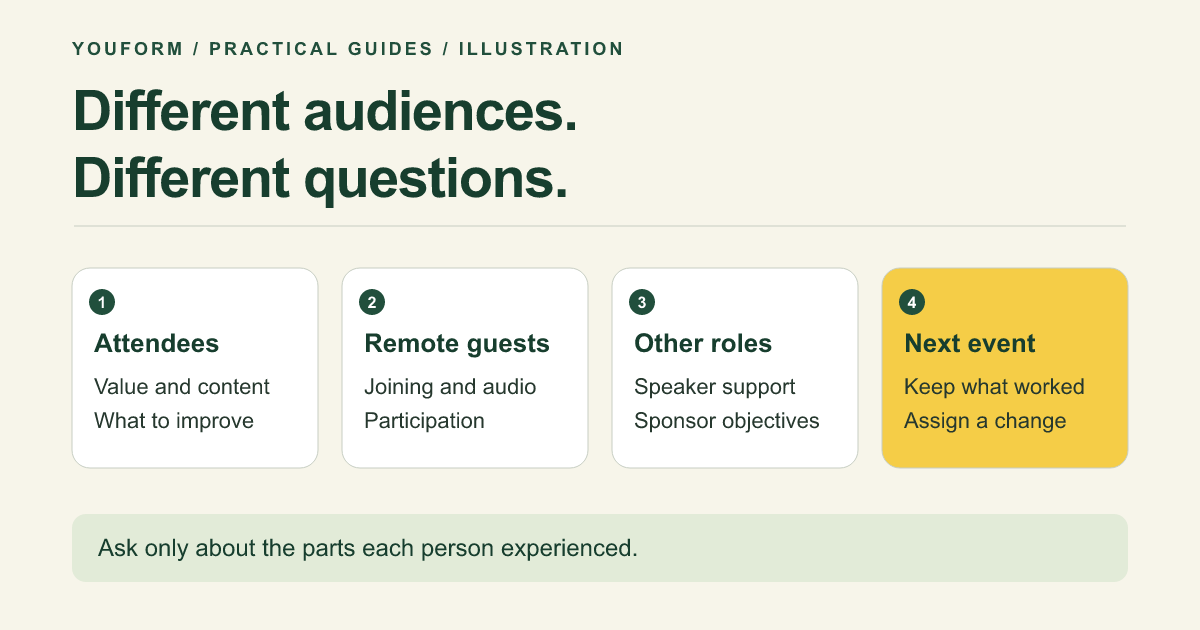
Start with the five-question example and add only questions tied to your next decision. Different audiences need different versions; no attendee needs all 30 questions in this bank.
Should we ask people to rate every speaker?
Only ask about sessions they attended, and only collect ratings you will use. A relevant follow-up on one session can be more useful than a long grid covering an entire conference.
Can we use a QR code at the venue?
Yes, link a QR code to the published survey and give attendees a direct-link alternative. Explain that responses go to the event team. A QR code changes access, not privacy or where the data is stored.
Sources and review notes
Updated November 11, 2026; original publication October 12, 2026. Question examples and debrief are editorial suggestions. References include the University at Buffalo's event question examples, Pew's survey-writing guidance, and Youform's logic documentation. No event responses were collected for this guide.